In the digital age, customers no longer make purchases through a linear path. They might research products on social media, compare them on a website, and only then decide to buy at a physical store or through another platform. This makes understanding the customer journey a key factor in helping businesses create a consistent and effective experience.
However, with so many touchpoints, businesses especially SMEs often struggle to fully track and manage customer information. This is where CRM systems come into play, helping businesses not only understand the entire customer journey but also optimize every interaction step.
In this article, we will explore what the Customer Journey is and how CRM can help businesses manage customers more intelligently and effectively.
1. What is the customer journey?

The Customer Journey is the entire process a customer goes through when interacting with a brand, from the moment they are unaware of the business until they become a loyal customer. This journey includes various touchpoints such as advertisements, websites, social media, sales teams, or customer service.
Unlike the marketing funnel, which focuses on the conversion process, the customer journey emphasizes the actual experience at each stage. This helps businesses view issues from the customer's perspective rather than focusing solely on pure sales goals.
2. Why is the customer journey important?
In an increasingly competitive market, a good product alone is not enough to retain customers. Modern consumers do not only care about price or quality; they also focus on the overall experience throughout their interaction with a brand.
Therefore, understanding what customers are thinking, doing, and expecting at each touchpoint has become a key factor in helping businesses create a competitive advantage. This is when the concept of the customer journey becomes more important than ever.
Understanding the customer journey helps businesses grasp the needs, behaviors, and emotions of customers at every moment. From there, businesses can provide more suitable outreach strategies to the right person at the right time.
Additionally, optimizing the customer journey helps improve the overall experience, minimize pain points, and increase satisfaction levels. When customers have a positive experience, the likelihood of them returning to make a purchase or recommending the brand to others is higher.
Finally, a well-designed customer journey directly contributes to increasing conversion rates, optimizing marketing costs, and enhancing Customer Lifetime Value.
3. Stages of the customer journey
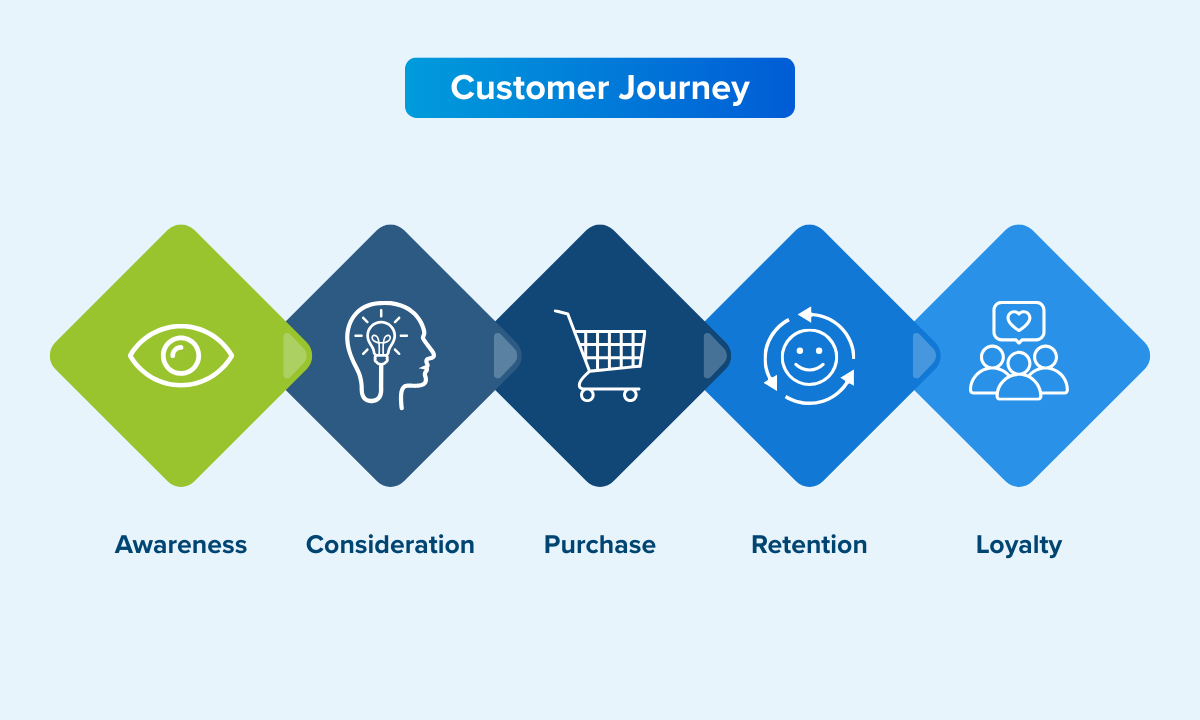
Awareness
This is the initial stage where customers first encounter a brand or recognize their own needs. They may reach a business through various channels such as online advertising, social media, search engines, or word-of-mouth.
At this stage, the business's goal is to capture attention and create a positive first impression, helping customers remember the brand among countless market options.
Consideration
After becoming aware, customers enter the research and comparison phase. They actively seek information about products/services, read reviews, check ratings, or compare different brands.
This is a critical time for businesses to provide useful, transparent, and persuasive content to help customers clearly understand the product's value. Factors such as brand reputation, content quality, and user experience significantly influence the customer's decision.
Decision
At this stage, the customer is nearly ready to purchase and only needs a final "nudge" to decide. Factors such as pricing, promotions, warranty policies, support services, or brand trust play a decisive role.
Businesses must ensure the purchasing process is fast, convenient, and frictionless. A seamless buying experience helps increase conversion rates and reduces the risk of customers dropping out at the last minute.
Service & Retention
The journey does not end after the customer makes a payment. This stage focuses on providing support, answering inquiries, and delivering added value to ensure customers are satisfied with their choice, thereby reducing churn rates.
Loyalty & Advocacy
When the experience throughout the journey is optimized, customers not only return for repeat purchases but also become voluntary brand advocates, helping the business attract new customers at zero cost.
4. Challenges in identifying the customer journey
One of the biggest challenges in building a customer journey is accurately identifying "bottlenecks" (pain points) – where the experience is interrupted and customers easily "give up" at the last minute. In reality, these issues are often not very large but appear at sensitive moments, directly affecting the purchasing decision.
For example, a customer may have spent time researching a product and adding it to their cart, only to leave because the website takes a few seconds to load, product information is unclear, or the checkout process has too many steps. In other cases, failing to receive a timely response from customer service is enough to make them lose trust and switch to a competitor.
The difficulty here is that "pain points" are not always easy to see. They are often scattered across various touchpoints – from marketing and sales to after-sales service – and if a business does not have a complete data tracking system, it is very difficult to pinpoint exactly where the problem lies. Many SMEs only realize there is an issue when conversion rates are low or churn is high, but they do not know the specific cause.
Therefore, identifying and addressing bottlenecks needs to be done systematically. Businesses need to:
- Track customer behavior at every touchpoint
- Collect real-world feedback from users
- Analyze data to detect unusual drop-off points
When "pain points" are identified and improved, the customer journey becomes more seamless and pleasant. This not only helps reduce churn rates but also significantly increases conversion potential, while building a positive experience that keeps customers coming back in the future.
5. What is CRM?
The concept of CRM
CRM (Customer Relationship Management) is a system that helps businesses manage all customer information and interactions throughout their entire lifecycle. It is not just software but also a strategy aimed at building and maintaining long-term relationships with customers.
CRM allows for the centralized storage of customer data, from personal information and purchase history to previous interactions. As a result, businesses can gain a more comprehensive understanding of their customers.
The role of CRM in business
CRM plays a vital role in connecting departments such as marketing, sales, and customer service. All synchronized data helps the business work more efficiently and avoids fragmented information.
In addition, CRM helps automate many processes such as sending emails, customer care, or tracking sales opportunities. This not only saves time but also improves operational accuracy.
More importantly, CRM supports the personalization of the customer experience—a key factor in customer retention in the digital age.
6. Applying CRM to effective customer journey management

Customer data collection & management
CRM helps businesses collect data from various sources such as websites, social media, email, or points of sale. All information is stored centrally, making it easy to track and manage. Consequently, businesses can segment customers based on behavior, needs, or potential levels, thereby developing appropriate strategies for each group.
Lead scoring
An important practical application is the ability to score potential leads. Based on interaction history (such as email open rates or pages viewed), CRM helps the sales team identify which customers are at the "hottest" stage to prioritize consultation, rather than spreading resources too thin.
Personalizing the experience
One of the greatest benefits of CRM is the ability to personalize. Based on the data collected, businesses can send content, offers, or messages tailored to each individual customer.
For example, new customers receive a welcome email, while existing customers may receive exclusive offers or special care programs. This helps customers feel valued and increases brand engagement.
Marketing & sales automation
CRM allows for the automation of many marketing and sales activities, such as drip email campaigns, follow-up reminders, or sales pipeline management.
Through automation, businesses can maintain continuous interaction with customers without consuming too many resources. At the same time, tracking customer behavior becomes easier, helping the sales team reach out at the right moment.
Journey analysis & optimization
CRM provides reports and analytical data that help businesses understand the effectiveness of each touchpoint in the customer journey.
From there, businesses can identify the stages where customers drop off the most, which channels yield high efficiency, and where improvements are needed. Continuous optimization based on data ensures the customer journey becomes increasingly refined.
By combining insights into the customer journey with a CRM system, businesses can create more effective marketing and sales strategies. Every decision is based on actual data rather than intuition.
This combination improves the customer experience at every touchpoint, thereby increasing conversion rates and satisfaction levels. Customers do not just make a purchase; they tend to return and become loyal customers.
In the long run, businesses will increase revenue, optimize costs, and build sustainable relationships with their customers.
7. Conclusion
The customer journey is the core factor determining a business's success in attracting and retaining customers. When a business thoroughly understands each stage and optimizes the experience, its competitiveness is significantly enhanced.
The application of CRM not only helps manage customers effectively but also serves as a powerful tool to systematically optimize the entire customer journey. It is time for businesses to invest seriously in building and managing the customer journey, combined with CRM technology, to create a sustainable competitive advantage in the market. Contact us for a consultation and to receive free documents on CRM software that helps businesses manage customers effectively.