In many businesses in Vietnam, each department still operates using isolated tools: sales manages customers with Excel, operations tracks orders via consolidated files, and accounting manually inputs data from various sources. This fragmentation leads to inconsistent data, slow processes, and makes it difficult for the business to scale.
The ERP (Enterprise Resource Planning) management system was created to connect all departments into a unified system, where data is synchronized in real-time and all operating procedures become smoother. Discover how ERP operates and connects departments in the article below.
1. Sales Department: Accelerate sales and enhance customer experience

Within an ERP system, CRM (Customer Relationship Management) is a crucial module that helps the Sales department manage all sales activities on a unified platform. The CRM module brings several key values:
- Centralized Customer Management: Stores information, interaction history, needs, and transaction records for each customer, allowing Sales staff to quickly grasp the full picture.
- Sales Pipeline Tracking: Monitors leads through each stage, evaluates conversion rates, and prioritizes potential opportunities.
- Quick Quotation Creation and Management: Sales staff can create quotes using standard templates, automatically update prices, discounts, and taxes, and directly convert them into sales orders.
- Reduced Manual Operations: When a quote or booking is created, the data is transferred directly to other modules (operations, accounting), limiting re-entry and avoiding errors.
- Real-time Sales Reports: The dashboard displays revenue, the performance of individual Sales staff, and revenue forecasts, helping leadership evaluate and make decisions quickly.
Thanks to the CRM module within the ERP, the Sales department works more efficiently, reduces information errors, shortens the sales cycle, and delivers a consistent, professional experience to customers.
2. Operations department: Reducing manual tasks by 60%

ERP helps the Operations department process orders faster, more accurately, and significantly reduce the volume of manual data entry. Key benefits include:
- Automatic Order Information from Sales: Every closed booking/quotation is transferred directly into the operations module without the need for data re-entry.
- Centralized Shipment and Trip Management: Track order status, schedules, delivery/receiving schedules, and assign drivers/warehouses on a single screen.
- Automatic Cost and Documentation Updates: Transportation, warehousing, and surcharges are recorded per order, preventing errors and missing documentation.
- Reduced Delivery Errors: Minimizing errors when operating on Excel while ensuring all related departments view the same data source.
- Real-time Progress Tracking: Operations gains visibility into shipment location, status, and progress, helping them quickly resolve issues and optimize the operational flow.
Thanks to a seamless process and standardized data, the Operations department can reduce the volume of manual tasks by up to 60% while improving the accuracy and speed of order processing.
3. Accounting – finance department: Automate reconciliation and reporting

ERP helps the Finance department operate more accurately, reducing the time spent compiling data and minimizing discrepancies between departments. The key benefits include:
- Automatic Data Reception from Sales and Operations: Revenue, costs, accounts receivable/payable (debt), order statuses, etc., are updated as soon as they arise, eliminating the need for manual entry of each item.
- Quick Reconciliation per Order: The system automatically links the revenue – cost – debt of each shipment/booking, allowing for easy and transparent variance checks.
- Rapid Invoice and Voucher Generation: Invoices, receipts/payments, and reconciliation minutes are created from existing data, reducing errors and saving time.
- Real-time Financial Reports: Revenue, cash flow, accounts receivable/payable, and profit are displayed instantly on the dashboard, supporting quick decision-making by the management board.
- Reduced Data Errors: Since data flows seamlessly across modules, the accounting staff does not have to manually compile information from multiple files or different departments.
Thanks to the ERP, the Accounting – Finance department can both reduce its processing workload and ensure that the data is accurate, transparent, and readily available.
4. Inventory warehouse department: Accurate inventory management
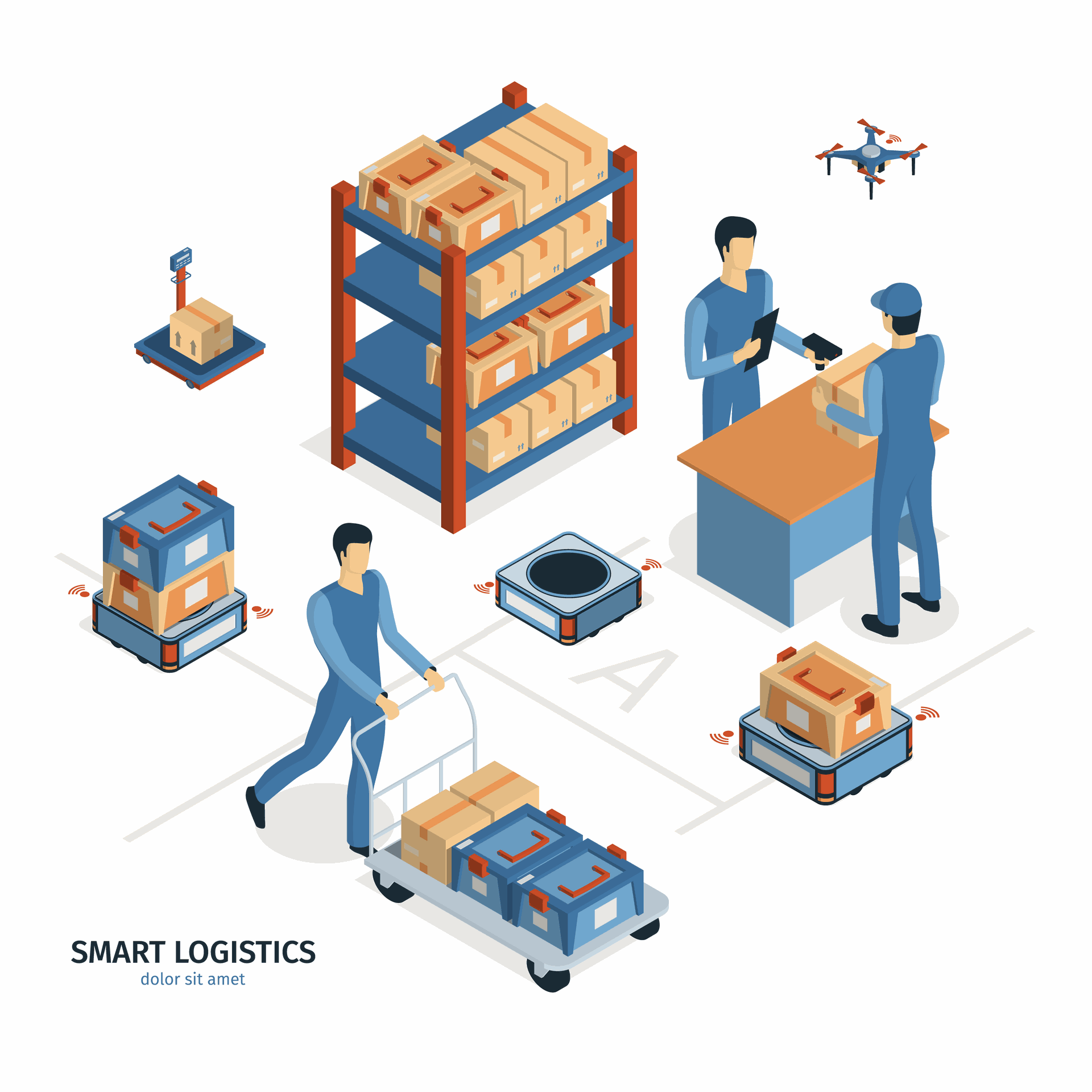
The Warehouse Module (Inventory Module) in ERP helps businesses control goods in real-time and minimize errors:
- Automated Inventory Tracking: Quantity, location, lot number, and serial number are updated immediately upon every inbound or outbound transaction.
- Direct Link to Operations: When a shipping order or delivery/receiving order is created, the warehouse is notified and updated instantly.
- Standardized Inbound-Outbound Process Management: Reduces document confusion and minimizes errors in handling goods.
- Reduced Inventory Discrepancies: Synchronized data prevents mismatches between warehouse records and accounting data.
- Real-time Inventory Reports: Helps with accurate planning for procurement, replenishment, and demand forecasting.
Thanks to synchronization and real-time capabilities, the warehouse department operates smoothly, reducing loss/shrinkage and optimizing warehousing costs.
5. Human Resources (HR) Department: Standardizing data and optimizing internal pperations

ERP supports HR in comprehensively managing personnel information and administrative procedures:
- Centralized Personnel Record Storage: Contracts, personal information, performance reviews, position changes, etc., are managed uniformly.
- Tracking Timekeeping – Shifts – KPIs: The system records automatically, reducing manual compilation time.
- Data Linkage with Payroll: Timekeeping data, allowances, bonuses, and penalties are transferred directly to the accounting/payroll module.
- Standardizing Approval Procedures: Leave requests, business travel, and internal requests are processed quickly.
- Rapid Personnel Reporting: Helps HR track the status of personnel and allocate resources appropriately.
ERP helps the Human Resources department reduce repetitive tasks and enhance the internal employee experience.
6. The board of directors: Making accurate decisions based on real-time data

ERP provides leadership with a comprehensive picture of business operations:
- Real-time overview dashboard: Revenue, costs, inventory, profit, and the performance of each department.
- Consistent data from multiple departments: Prevents contradictory figures or delayed reports.
- Identification of operational bottlenecks: Makes it easy to view bottlenecks and determine optimization directions.
- Business results forecasting: Supported by monthly/quarterly/annual reports.
- Support for strategic decisions: Scaling operations, restructuring processes, and cost optimization.
With ERP, the Board of Directors can make faster and more accurate decisions based on reliable data.
7. Conclusion
ERP is more than just software to support operations; it is a platform that connects all departments within the enterprise into a unified system. When data is synchronized in real-time and processes are standardized, businesses significantly reduce manual errors, accelerate order processing, and enhance the customer experience. More importantly, ERP gives leadership a holistic view, allowing them to assess operational effectiveness and make more precise strategic decisions.
For businesses struggling with disjointed processes and a lack of connection between departments, ERP is the core solution for optimizing operations and creating a long-term competitive advantage. Contact us to receive free documentation and consultation on the latest technology solutions.